
MARCH 2024
could ai lead to better design collaboration for architects?
My previous post was, in its own way, a story about the impact technology has had on the way architects go about their work.
Having experienced significant change in the way we explore and represent our designs, leaving behind the abstraction of 2D drawings to embrace data-rich 3D virtual environments, we are now seeing artificial intelligence finesse the underlying technology by making it more efficient and self-generating.
Inevitably this will lead to the semi-automated delivery of building documentation, and we will therefore see ourselves increasingly focussing on the early conceptual phase of projects. We will accordingly need to adapt our skills and the way we organise ourselves to do our work.
Architects have traditionally worked in teams. Those teams typically reflect the broader hierarchy of the practice and incorporate specialist knowledge and explorations. Tasks are assigned and streams of work collated. That teamwork structure supports a work flow that may start at conceptual design and end at the completion of the project.
When the delivery of documentation becomes automated our primary focus will be the generation of ideas. We will shift from a teamwork structure reliant on specialists to a collaborative dynamic driven by inquisitive people with broad knowledge able to connect disparate potentials.
The capability of artificial intelligence to collate targeted research means that we will find ourselves increasingly using AI to provide the information necessary to underpin our design. Whereas peoples' specialist knowledge and advice has inherent limitations to its dissemination, AI knowledge has almost unlimited potential for widespread use. Design will therefore become more enriched by and dependent on knowledge because of the immediacy of access to that information.
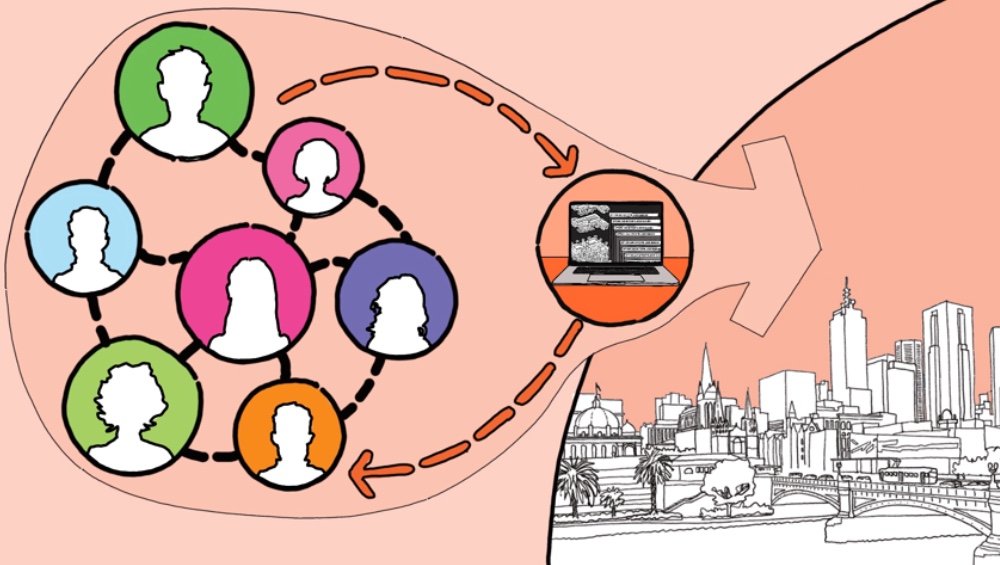
However we will need a way of assessing the information provided by AI and so specialists will find their role changing accordingly. Once a portal to knowledge, and therefore in control of the flow of that information, specialists will now be reviewing information derived from AI enquiries and, in a feedback loop, providing updated knowledge back to AI systems.
Whether the human kind or AI, specialist knowledge reflects pre-existing contexts, which may be legal or theoretical or rules of thumb. If the possibilities of the project we are looking at change the old contexts or create new contexts, then specialist knowledge, based on experience, becomes out of date and needs to be reconsidered.
The way humans think- our analogical thinking, which takes the new and makes it familiar, our creative leaps- should make us faster at updating knowledge in response to new circumstances.
The changing contexts reflects the changing world. As Dror Poleg notes in his book Rethinking Real Estate "Technology is undermining the foundations of real estate asset value. It is changing the way humans use retail, office, residential, lodging and industrial space. It is redefining the meaning of location, visibility, and accessibility. It is democratizing access to capital, relationships and information."
Much of our work as architects relates to complex scenarios without obvious solutions at the start. We can be faced with an evolving set of interlocking possibilities and constraints. We may not properly understand a problem until we develop and assess a solution. There are usually many stakeholders who may not agree. Constraints can change over time and there is usually no definitive solution, but more likely a range of optimal solutions yet to be discovered.
As each project has its own singular overlap of political, social, statutory and physical contexts, and the intersection of those with programmatic possibilities and financial limitations, the basis of what we are doing may be unknown or indistinct. Information may be missing because we haven't discovered it yet. Feedback necessary to confirm or question potential scenarios may well be in the future.
This complex and changing world will need people of diverse experience and interdisciplinary thinking. Conceptual skills that can connect new ideas and work across contexts will be required, together with a collaborative structure to leverage those talents.
In the podcast Bjarke Ingels to Cities: take a Longer View Ingels makes the observation that it doesn't matter where an idea comes from or why it is proposed, what matters is why it is selected. Such a notion is intrinsic to collaboration and is illustrative of the advantage of drawing a wide range of skills and personalities into collaborations.
Collaboration is inhibited by hierarchy. We need also to reduce locational limitations to allow the best people to collaborate no matter where they are located.
In the short term we will therefore find video conferencing providing a more sympathetic and effective environment for collaboration that the traditional in-person interactions. As immersive virtual environments become increasingly available through the reduction in computer power needs, and become more familiar, those will become the venue of choice.